10-Day Complete Online Course DDC 23rd Edition

Dewey Decimal Classification
DDC 23rd Edition Masterclass

From Numbers to Knowledge — Let’s Classify Together!

Learn Today, Build a Brighter Library Tomorrow!

10 Days
Structured Online
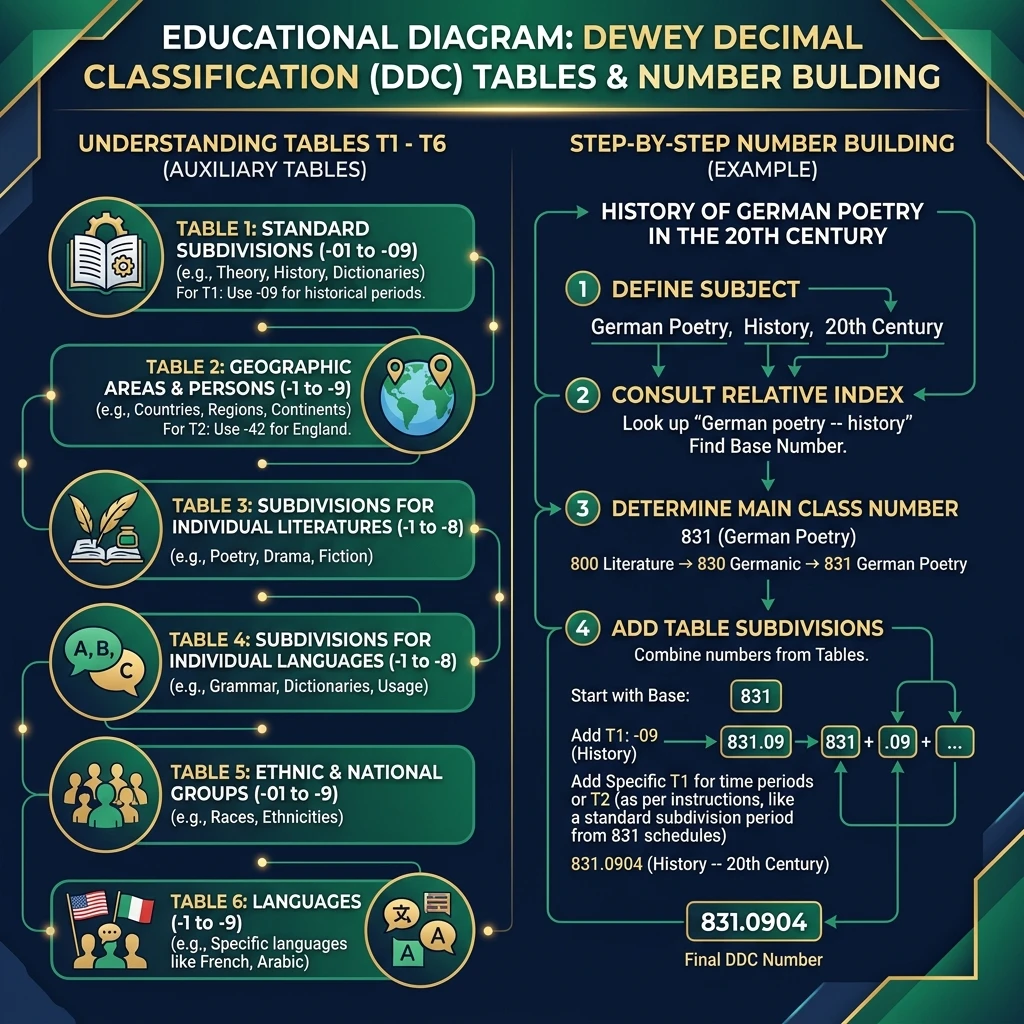
Tables 1–6
In-depth Practice
Number Building
Step-by-Step
Certificate
On Completion
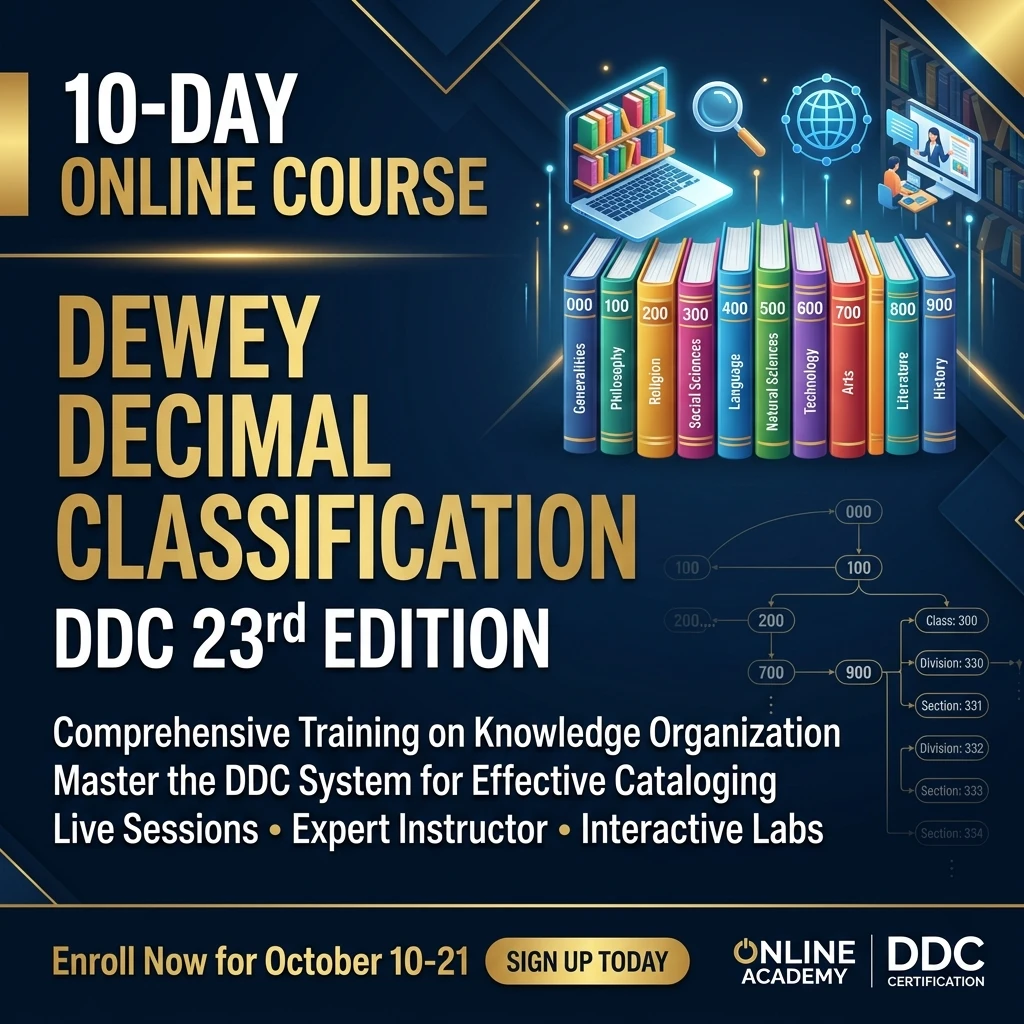
DDC 23rd Edition Course Banner
Structured Learning
Schedules • Tables • Index • MCQs
23rd Edition

Workshop Schedule & Fee Structure

Workshop dates, daily session times and the fee structure are published on the registration form. Open it to check the details and register.

01. Executive Summary

About The Course

Digital Resources & Training Centre (DRC), New Delhi presents a comprehensive 10-Day Online Course on Dewey Decimal Classification (DDC), 23rd Edition, designed to take learners from the fundamentals of DDC to practical classification, tables, relative index, number building and exam-oriented practice.

Understanding DDC requires more than memorising numbers. A successful learner needs to understand the structure and philosophy, 10 Main Classes, hierarchy & notation, schedules & subdivisions, DDC Tables 1–6, Relative Index, step-by-step number building, classification of actual titles, and practical decision-making.

Our Proven Learning Methodology
Concept → Schedule → Tables → Practice → Application → Examination
DDC Tables and Number Building Infographic
Practical Application Focus
Designed for both beginners and experienced library professionals
Learning Outcomes

02. Course Objectives

By the end of the programme, participants will be able to:

Understand the basic philosophy and structure of DDC.
Explain the development and major features of DDC.
Understand the 10 Main Classes and their subdivisions.
Navigate DDC schedules systematically.
Identify appropriate classification numbers for subjects.
Use DDC Tables effectively.
Understand and apply Tables 1–6.
Use the Relative Index for subject identification.
Build classification numbers step-by-step.
Apply classification principles to actual book titles.
Solve DDC-based MCQs & practice questions.
Prepare for LIS examinations involving DDC.
Day-Wise Syllabus

03. 10-Day Detailed Course Schedule

Click any day to view topics covered and practical focus:

Topics Covered:
  • What is DDC?
  • Melvil Dewey and the development of DDC
  • History and editions of DDC
  • Basic structure of DDC
  • Understanding the DDC hierarchy
  • The 10 Main Classes
  • How to read a DDC schedule
  • Basic notation and classification concepts
Practical Focus: Participants are introduced to the fundamental process of moving from a subject → schedule → number.
Topics Covered:
  • 000–099: General works
  • 100–199: Philosophy & psychology
  • Detailed study of important numbers
  • Major subdivisions
  • Subject identification
  • Classification examples
  • MCQs and practice questions
Practical Focus: Understanding how general subjects, information, computer-related areas, philosophy and psychology are represented within DDC.
Topics Covered:
  • Structure of the 200s
  • Major religious subjects
  • Important subdivisions
  • Scope and coverage
  • Classification principles
  • Practical classification examples
  • MCQs and exercises
Practical Focus: Participants practise identifying appropriate classification numbers for religious subjects and related topics.
Topics Covered:
  • Structure of the Social Sciences
  • Key subject areas
  • Major subdivisions
  • Important numbers
  • Number selection
  • Classification practice
  • Practical examples & MCQs
Practical Focus: Classification of subjects related to society, economics, law, education, government and other social science areas.
Topics Covered:
  • Structure of the 400s
  • Important language divisions
  • Major subdivisions
  • Use of Table 4 — Subdivisions of Individual Languages
  • Use of Table 6 — Languages
  • Classification examples & MCQs
Practical Focus: Participants learn how language-related subjects are represented and how relevant tables can be used to construct numbers.
Topics Covered:
  • Structure of the Science class
  • Key scientific subjects
  • Important subdivisions
  • Classification examples
  • Use of tables where required
  • Subject analysis & MCQs
Practical Focus: Classification of books and information resources dealing with mathematical, physical, chemical, biological and related sciences.
Topics Covered:
  • Structure of Technology
  • Major subject areas
  • Use of Table 1 — Standard Subdivisions
  • Use of Table 5 — Ethnic & National Groups
  • Important subdivisions
  • Classification examples & MCQs
Practical Focus: Participants work with practical examples from technology and applied sciences.
Topics Covered:
  • 700–799: Arts & recreation
  • 800–899: Literature
  • Important subjects and subdivisions
  • Use of Table 3 — Subdivisions for Individual Literatures
  • Use of Table 4 — Subdivisions for Individual Languages
  • Classification examples & MCQs
Practical Focus: Special attention is given to literature and the use of appropriate tables for constructing classification numbers.
Topics Covered:
  • Structure of the 900s
  • History
  • Geography
  • Important areas and subdivisions
  • Use of Table 2 — Geographic Areas, Historical Periods & Biography
  • Classification examples & MCQs
Practical Focus: Participants learn to handle geographic and historical aspects while constructing appropriate DDC numbers.
Topics Covered:
  • Complete overview of DDC Tables 1–6
  • Practical use of the tables
  • How to use the Relative Index
  • Step-by-step number building
  • Classification of actual book titles
  • Integrated classification exercises
  • Exam-oriented practice
  • Final Mock Test
Practical Focus: Brings together concepts covered throughout the course, focusing on actual classification problems and practical number construction.
04. Table Breakdown

Special Focus: DDC Tables 1–6

A major component of this programme is the practical understanding of the DDC tables. Rather than simply explaining the tables theoretically, the course emphasises when, why and how to use them during actual classification.

Table Focus & Application
Table 1 Standard Subdivisions
Table 2 Geographic Areas, Historical Periods & Biography
Table 3 Subdivisions for Individual Literatures
Table 4 Subdivisions for Individual Languages
Table 5 Ethnic & National Groups
Table 6 Languages
Key Competencies

05. What You Will Learn Beyond The Schedule

Relative Index

Learn how to locate subjects through the Relative Index and connect them with the appropriate DDC schedules.

Number Building

Understand the process of constructing classification numbers systematically instead of relying only on memorisation.

Actual Book Classification

Work with realistic book titles and subject statements to understand how DDC is applied in practice.

Exam-Oriented MCQs

Practise questions designed around commonly tested DDC concepts, tables, schedules and classification principles.

Quick Revision

Develop concise revision points for reviewing important concepts before examinations.

Final Mock Test

Test your understanding through an integrated final assessment covering the major areas of the course.

Structured Progression

06. Course Methodology

01
Understand
Build a strong conceptual foundation.
02
Explore
Study schedules & subdivisions.
03
Apply
Use tables & principles.
04
Practise
Classify examples & questions.
05
Review
Revise tested concept areas.
06
Assess
MCQs and final mock test.

07. Learning Resources & Course Benefits

Participants will receive access to a combination of learning and practice resources, including:

Live / Recorded Classes
Study Notes in PDF Format
Practice Questions
DDC-Based MCQs
Practical Classification Exercises
DDC Tables-Based Practice
Relative Index Practice
Number-Building Exercises
Exam-Oriented Questions
Quick Revision Material
Final Mock Test
Certificate of Completion
Target Audience

08. Who Can Join?

Library & Info Science Students

Students who want to develop strong fundamentals in classification and improve academic performance.

Library Science Aspirants

Learners preparing for UGC-NET, KVS, NVS, and state library science recruitment examinations.

School Librarian Aspirants

Candidates preparing for school librarian recruitment examinations and interviews.

College & Academic Librarians

Working professionals who want to strengthen their practical knowledge of DDC in daily library operations.

Competitive Examination Candidates

Candidates preparing for examinations where DDC and library classification form part of the syllabus.

Beginners in LIS

Anyone beginning their journey in Library & Information Science looking for structured training.

Who Should Attend? (Career Path Continuum)
A Student → An Aspirant → A New Librarian → A Working Professional → An Academic Librarian → An Examination Candidate

09. Why Learn DDC Practically?

DDC knowledge is valuable for professionals involved in:

Classification of library materials
Technical processing
Cataloguing & classification departments
Collection organisation
Shelf arrangement
Library automation and metadata work
Academic library operations
Competitive examinations
Professional library practice
The objective of this programme is to help learners move from “knowing DDC” to “using DDC.”
Program Overview

10. Course Highlights

10 Days
Structured learning journey covering major DDC classes & practical applications.
Complete DDC Foundation
From introduction & history to schedules, tables & number building.
Tables 1–6
Dedicated attention to the major DDC tables and their practical use.
Practical Classification
Work with actual subjects and book-title examples.
MCQs & Practice
Reinforce learning through regular questions and exercises.
Exam Focus
Designed to support preparation for LIS competitive examinations.
Beginner-Friendly
Concepts introduced progressively before moving to practical applications.
Certificate
Certificate of Completion for participants completing the programme.

11. Suggested Learning Outcome Flow

DDC Fundamentals → 10 Main Classes → Schedules → Tables → Relative Index → Number Building → Practical Classification → MCQs → Mock Test
Institutional Profile

12. About the Organiser

Digital Resources & Training Centre (DRC), New Delhi
Strengthening the LIS Community
10,000+
LIS Learners Trusted Across India

Digital Resources & Training Centre is a professional learning and training initiative focused exclusively on Library & Information Science. DRC works towards strengthening the LIS community through:

Professional training & skill-development
Library automation training
Koha and DSpace training
Research support services
LIS-focused workshops & webinars
Seminars & capacity-building
Promotion of LIS R&D
Practical, technology-oriented learning opportunities

Our approach is practical, user-focused and result-oriented, with programmes designed around the evolving requirements of students, library professionals, researchers and LIS aspirants.

14. Course Philosophy

Understand. Practise. Apply. Succeed!

DDC is not simply a collection of numbers. It is a systematic approach to organising knowledge. This course aims to help learners understand the logic behind classification, develop practical skills and gain confidence in solving classification problems.
15. Registration & Contact

Digital Resources & Training Centre

New Delhi • Strengthening the LIS Community

Follow DRC for upcoming workshops, training programmes, LIS resources, MCQs, career updates and professional learning opportunities.

Knowledge Organised | Libraries Strengthened | Careers Empowered