Researchers use big databases to find papers and evidence.
Some have been around for decades.
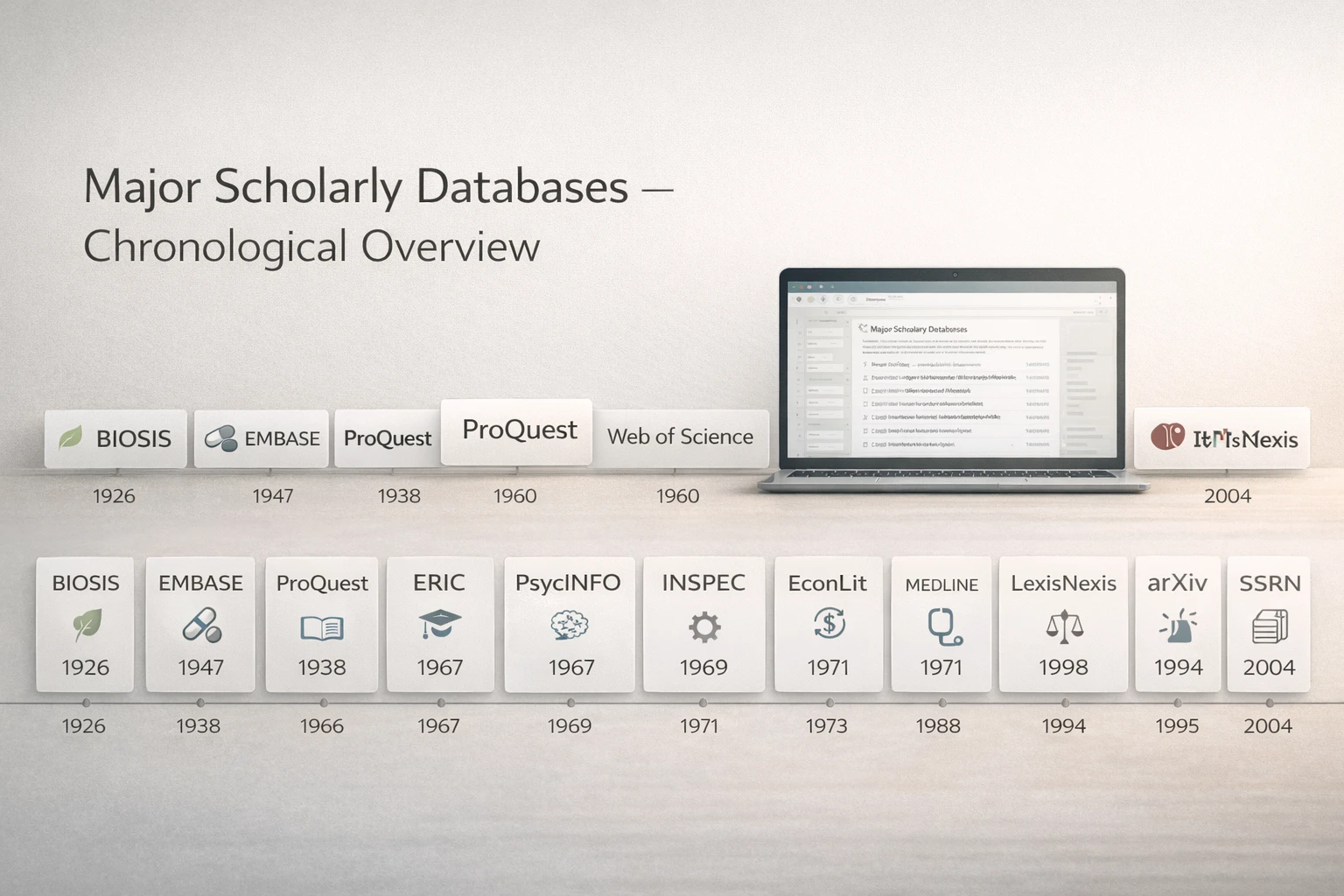
This post lists major databases in order of launch.
Each entry shows the launch date, subject area, and who runs it.
Links go to the official pages so you can check details.
Why this list matters
These databases shape how we search and cite.
They help students, librarians, and researchers find trusted sources.
Knowing the database focus helps you pick the right one fast.
Chronological overview of major databases
Dates are shown as provided. Follow the links for official product pages and current service details.
1. BIOSIS — Launched 01/01/1926
Subject: Life Sciences
Organization: Clarivate
Official: https://clarivate.com/products/biosis-previews/
2. EMBASE — Launched 01/01/1947
Subject: Biomedical & Pharmacology
Company: Elsevier
Official: https://www.elsevier.com/solutions/embase
3. ProQuest — Launched 01/01/1938
Subject: Multidisciplinary
Company: ProQuest LLC
Official: https://www.proquest.com/
4. Web of Science — Launched 01/01/1960
Subject: Multidisciplinary
Company: Clarivate
Official: https://www.webofscience.com/
5. ERIC — Launched 01/01/1966
Subject: Education
Organization: U.S. Department of Education
Official: https://eric.ed.gov/
6. PsycINFO — Launched 01/01/1967
Subject: Psychology
Organization: American Psychological Association (APA)
Official: https://www.apa.org/pubs/databases/psycinfo
7. INSPEC — Launched 01/01/1969
Subject: Physics, Engineering & Computing
Organization: IET
Official: https://www.theiet.org/publishing/inspec/
8. EconLit — Launched 01/01/1969
Subject: Economics
Organization: American Economic Association
Official: https://www.aeaweb.org/econlit/
9. Academic Search (EBSCO) — Launched 01/01/1969
Subject: Multidisciplinary
Company: EBSCO Information Services
Official: https://www.ebsco.com/products/research-databases/academic-search
10. MEDLINE — Launched 01/01/1971
Subject: Medicine & Health Sciences
Organization: U.S. National Library of Medicine
Official: https://www.nlm.nih.gov/medline/
11. LexisNexis — Launched 01/01/1973
Subject: Law, News & Business
Company: LexisNexis
Official: https://www.lexisnexis.com/
12. IEEE Xplore — Launched 01/01/1988
Subject: Engineering & Technology
Organization: IEEE
Official: https://ieeexplore.ieee.org/
13. arXiv — Launched 14/08/1991
Subject: Physics, Mathematics & Computer Science
Organization: Cornell University Library
Official: https://arxiv.org/
14. SSRN — Launched 01/01/1994
Subject: Social Sciences & Humanities
Organization: Elsevier (current owner / host)
Official: https://www.ssrn.com/
15. JSTOR — Launched 01/08/1995
Subject: Multidisciplinary
Organization: ITHAKA
Official: https://www.jstor.org/
16. PubMed — Launched 22/06/1996
Subject: Medicine & Life Sciences
Organization: National Library of Medicine (NIH)
Official: https://pubmed.ncbi.nlm.nih.gov/
17. SpringerLink — Launched 01/01/1996
Subject: STM (Science, Technology, Medicine)
Company: Springer Nature
Official: https://link.springer.com/
18. Cochrane Library — Launched 01/04/1996
Subject: Evidence-based Healthcare
Publisher: Wiley
Official: https://www.cochranelibrary.com/
19. MathSciNet — Launched 01/01/1996
Subject: Mathematics
Organization: American Mathematical Society
Official: https://mathscinet.ams.org/
20. ScienceDirect — Launched 01/03/1997
Subject: Science & Technology
Company: Elsevier
Official: https://www.sciencedirect.com/
21. HeinOnline — Launched 01/01/2000
Subject: Law & Legal Research
Company: William S. Hein & Co.
Official: https://home.heinonline.org/
22. DOAJ — Launched 01/01/2003
Subject: Open Access Journals
Organization: Directory of Open Access Journals
Official: https://doaj.org/
23. Scopus — Launched 04/11/2004
Subject: Multidisciplinary
Company: Elsevier
Official: https://www.scopus.com/
How to use the list
- Pick a database that matches your subject.
- Use its search filters (date, subject, author).
- Export citations to your reference manager.
- Compare results across two or three databases.
- Use Web of Science / Scopus for citation metrics when needed.
Quick tips
- Use subject-specific databases first for depth (for example, INSPEC for physics).
- Use multidisciplinary indexes (Web of Science, Scopus) to check citations and broader coverage.
- Use open services (arXiv, DOAJ) for free access when possible.
- Check license and access rules if your institution doesn’t subscribe.