');pointer-events:none;">
LIVE ONLINE WORKSHOP • BILINGUAL DRC DELHI

10-Day Master Workshop on
Library Cataloguing & Bibliographic Frameworks

AACR2R · ISBD · FRBR · RDA · CCF · MARC 21 · UNICODE — Theory understood, practice mastered, entries constructed live card-by-card & tag-by-tag.

📅
10 Days
Intensive Live
💻
Online Live
Interactive Zoom
🗣️
Bilingual
Hindi + English
🎓
E-Certificate
On Completion
10-Day Workshop on Library Cataloguing
✨ Practical Hands-On
Dual Training Format
AACR2 Cards + MARC 21 Tags
20 Cases
Executive Overview

About This Workshop

Cataloguing is the structural backbone of every library — and one of the most heavily tested, practical-intensive areas of UGC-NET, library job interviews, and day-to-day professional practice. Most learners know the theory but freeze when asked to actually construct a main entry, an added entry, a catalogue card, or a MARC 21 record for a real, complex document. This workshop bridges that exact gap.

Over 10 focused, hands-on sessions, you will practically construct main entries and added entries for 20 real-world special cases — from multi-author books to rare manuscripts — first as classical catalogue cards, and then as complete MARC 21 records, tag by tag.

✔ AACR2R Standard Cards
✔ MARC 21 Tagging Mastery
✔ Modern RDA & FRBR Rules
About 10-Day Workshop Page
Interactive Live Sessions
Guided by Experienced DRC Delhi Mentors
Key Differentiators

Why Join This Workshop?

🛠️

100% Practical Focus

Not just passive lectures — cataloguing entries are constructed live, step-by-step, during every session.

📇

Built Twice Every Time

Every case study is built as a traditional AACR2 card and as a machine-readable MARC 21 record.

📋

All 20 Special Cases

Covers every complex case scenario learners struggle with — in a clean, day-wise sequence.

📚

Frameworks + Theory

In-depth coverage of ISBD, FRBR, RDA, CCF, and UNICODE — linking classical cataloguing to modern standards.

🎯

Exam & Interview Ready

Targeted preparation for UGC-NET aspirants, viva-voce tests, and technical library interview rounds.

📝

Take-Home Resources

Printable worked-example notes and solution practice sheets (Card + MARC 21) shared after every class.
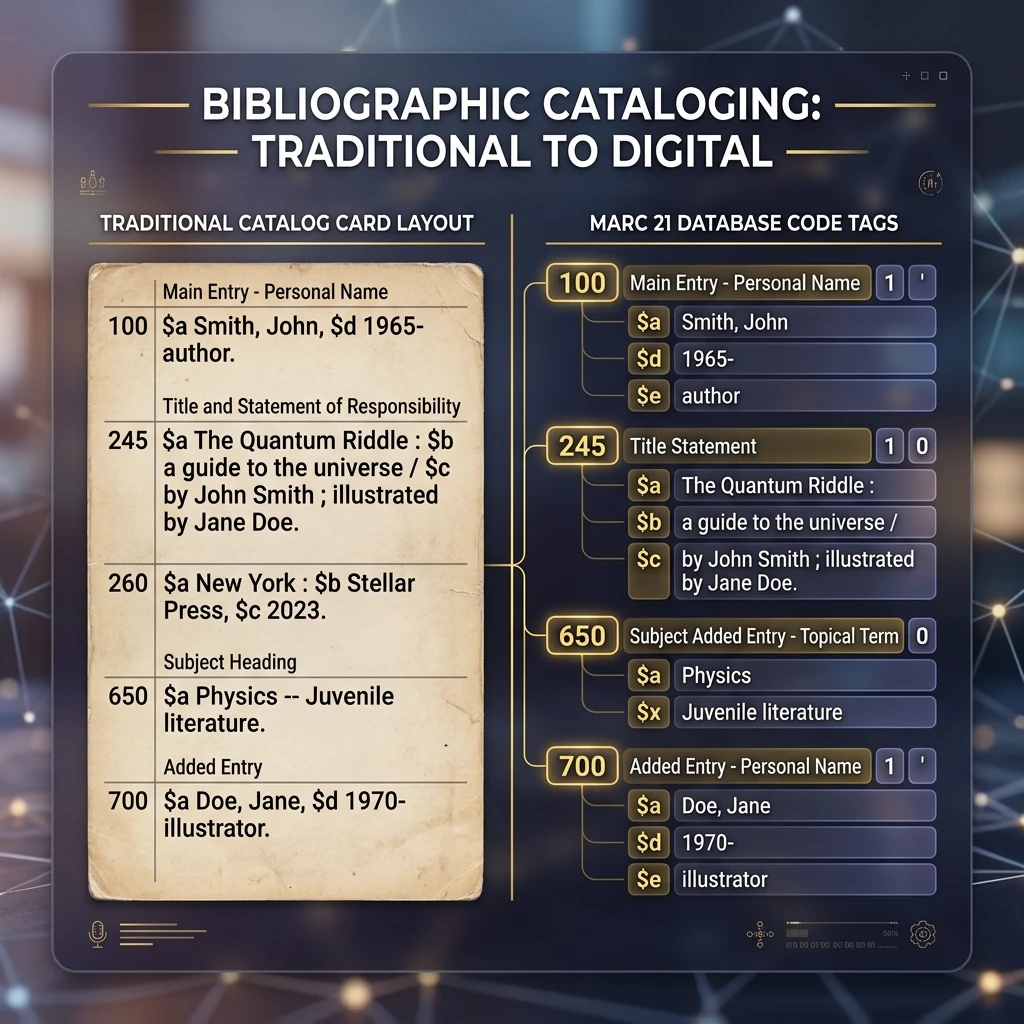
From Physical Cards to Digital MARC 21 Records
Dual Mastery Curriculum

From Physical Cards to Digital MARC 21 Records

Traditional cataloguing cards provide structural clarity, while MARC 21 powers modern OPACs and Koha ILS software. In this workshop, you learn how every element on a card translates directly into MARC 21 tags (100, 245, 260, 300, 650, 700).

✓ Main & Added Entries
✓ Subfield Indicators
✓ Tag Field Structure
✓ OPAC & ILS Ready

Who Should Join?

📖
UGC-NET / State LIS Aspirants
Practical cataloguing mastery for scoring higher in NET exams
🏛️
Working Librarians & Cataloguers
Sharpen MARC 21 skills for Koha and modern digital libraries
🎓
BLIS / MLIS Students
Complete preparation for university practical exams & viva
💼
Job Interview Candidates
Excel in technical cataloguing practical tests during interviews

📐 Foundational Topics Covered

✔ History & Evolution of Library Cataloguing
✔ Purpose & Objectives of Cataloguing
✔ Principles of Descriptive Cataloguing
✔ History of AACR2R — from 1967 to 2002 Revisions
✔ Structure of AACR2R — Part I (Description) & Part II (Headings)
✔ MARC 21 Record Structure — Leader, Directory & Control Fields
✔ Essential MARC 21 Variable Data Tags
✔ ISBD — The 9 Areas & Punctuation Patterns
Day-Wise Plan

10-Day Schedule at a Glance

Theme: Building the complete conceptual base — history, principles, AACR2R and MARC 21 — before touching a single practical case.

  • History & Introduction to Library Cataloguing — manuscript lists to OPACs
  • Purpose and Objectives (Cutter's Objects, Ranganathan's approach)
  • Principles of Descriptive Cataloguing — sources of information, levels, accuracy
  • History of AACR2R — AACR (1967) → AACR2 (1978) → AACR2R (1988/2002)
  • Structure of AACR2R — Part I: Description (Areas 1–8, ISBD-based); Part II: Headings
  • Introduction to MARC 21 — Leader, Directory, Control Fields & Variable Data Fields
  • Important MARC 21 Tags walkthrough
🛠️ Practical: Constructing a single-author entry — catalogue card + MARC 21 record (base case)
  • Two Author Entry — main and added entry construction
  • Three Author Entry
  • Four Author Entry
  • More than Four Authors — the Rule of Three and use of 'et al.'
🛠️ Practical: Main & added entries for each author-count scenario — card + MARC 21 (Tags 100, 245, 700)
  • Editor Entry — when editor becomes main entry heading vs. added entry
  • Compiler Entry — treatment for compiled/edited anthologies
  • Translator Entry — original author retained as main entry, translator as added entry
🛠️ Practical: Edited volume, compiled anthology, translated work — card + MARC 21 (Tag 700 relator terms)
  • Series Entry — series statement placement and series added entry
  • Corporate Author Entry — when a corporate body qualifies as main entry
  • Conference Proceedings — entry under conference name, place and date
🛠️ Practical: Series book, corporate report, conference proceedings — card + MARC 21 (Tags 110, 111, 490, 830)
  • Government Publications — entry under country/state and issuing department
  • Annual Reports — treatment of recurring institutional publications
  • Multi-Volume Books — collective vs. analytical entry approach
🛠️ Practical: Government dept. report, annual report, multi-volume set — card + MARC 21
  • Thesis & Dissertation — degree statement, university, year as special elements
  • Research Reports — sponsoring body and project details
  • Maps & Atlases — scale, projection and cartographic description
🛠️ Practical: PhD thesis, research report, atlas — card + MARC 21 (Tag 502 Dissertation Note, Tag 034 Cartographic Data)
  • Audio-Visual Materials — physical description for non-book media
  • Electronic Resources — e-books, databases, and online resource description
  • Rare Books & Manuscripts — special notes for provenance, edition and condition
🛠️ Practical: AV item, e-resource, rare/manuscript item — card + MARC 21 with special notes area
  • Subject Entries & Cross References — 'see' and 'see also' references
  • Filing Practice — word-by-word vs. letter-by-letter filing rules
  • Catalogue Card Preparation — full physical card layout and format
🛠️ Practical: Subject headings with cross-references, filing mixed card set — card + MARC 21 (Tags 600/650/651)
  • ISBD (deep dive) — applying the 9 Areas to entries built across the workshop
  • FRBR — WEMI model and the four user tasks (Find, Identify, Select, Obtain)
  • RDA — how RDA elements replace/extend AACR2R rules used earlier
  • CCF — structure and linking fields for record interchange
  • UNICODE / ISCII — encoding for bilingual (Hindi + English) records
  • Consolidated MARC 21 review — mapping AACR2R to MARC 21 across all case types
🛠️ Practical: Re-expressing 3 earlier entries through ISBD, FRBR/WEMI, and complete MARC 21 records
  • Integrated mock cataloguing test covering all 20 special case types — card + MARC 21 tagging
  • Quick-fire framework quiz (AACR2R / ISBD / FRBR / RDA / CCF / UNICODE / MARC 21)
  • Open doubt-clearing session
  • Feedback, exam-strategy tips, and certificate distribution
🎓 E-Certificate of Participation issued on completion

🗂️ 20 Special Practical Cases Covered

Every case worked out in two formats: traditional catalogue card + corresponding MARC 21 tagged record.

▸Three Author Entry
▸Four Author Entry
▸More than Four Authors
▸Editor Entry
▸Compiler Entry
▸Translator Entry
▸Series Entry
▸Corporate Author Entry
▸Conference Proceedings
▸Government Publications
▸Annual Reports
▸Multi-Volume Books
▸Thesis & Dissertation
▸Research Reports
▸Maps & Atlases
▸Audio-Visual Materials
▸Electronic Resources
▸Rare Books & Manuscripts
▸Subject Entries & Cross References
▸Filing Practice & Card Prep

🏷️ MARC 21 Tags Covered

All key tags are practiced through hands-on entry construction across the 10 days.

Tag Field Name
001 / 003 / 005Control Number, Control Number Identifier, Date & Time of Latest Transaction
008Fixed-Length Data Elements
010Library of Congress Control Number (LCCN)
020International Standard Book Number (ISBN)
040 / 041Cataloging Source / Language Code
082Dewey Decimal Classification Number
100Main Entry — Personal Name
110Main Entry — Corporate Name
111Main Entry — Meeting Name
130Main Entry — Uniform Title
245 / 246Title Statement / Varying Form of Title
250Edition Statement
260 / 264Publication, Distribution, etc.
300Physical Description
490 / 830Series Statement / Series Added Entry — Uniform Title
500 / 504 / 505General Note / Bibliography Note / Formatted Contents Note
502Dissertation Note (Thesis & Dissertation)
600 / 610 / 611Subject Added Entry — Personal / Corporate / Meeting Name
650 / 651Subject Added Entry — Topical / Geographic Term
700 / 710 / 711Added Entry — Personal / Corporate / Meeting Name
740Added Entry — Uncontrolled Related Title
Day 9 Deep Dive

Bibliographic Frameworks & Standards

Modern Standards & Conceptual Models

Modern Standards & Conceptual Models

Library cataloguing has transformed from physical card files to linked data, FRBR entity modeling, and RDA standards. Our workshop connects classical AACR2 rules directly with modern bibliographic standards.

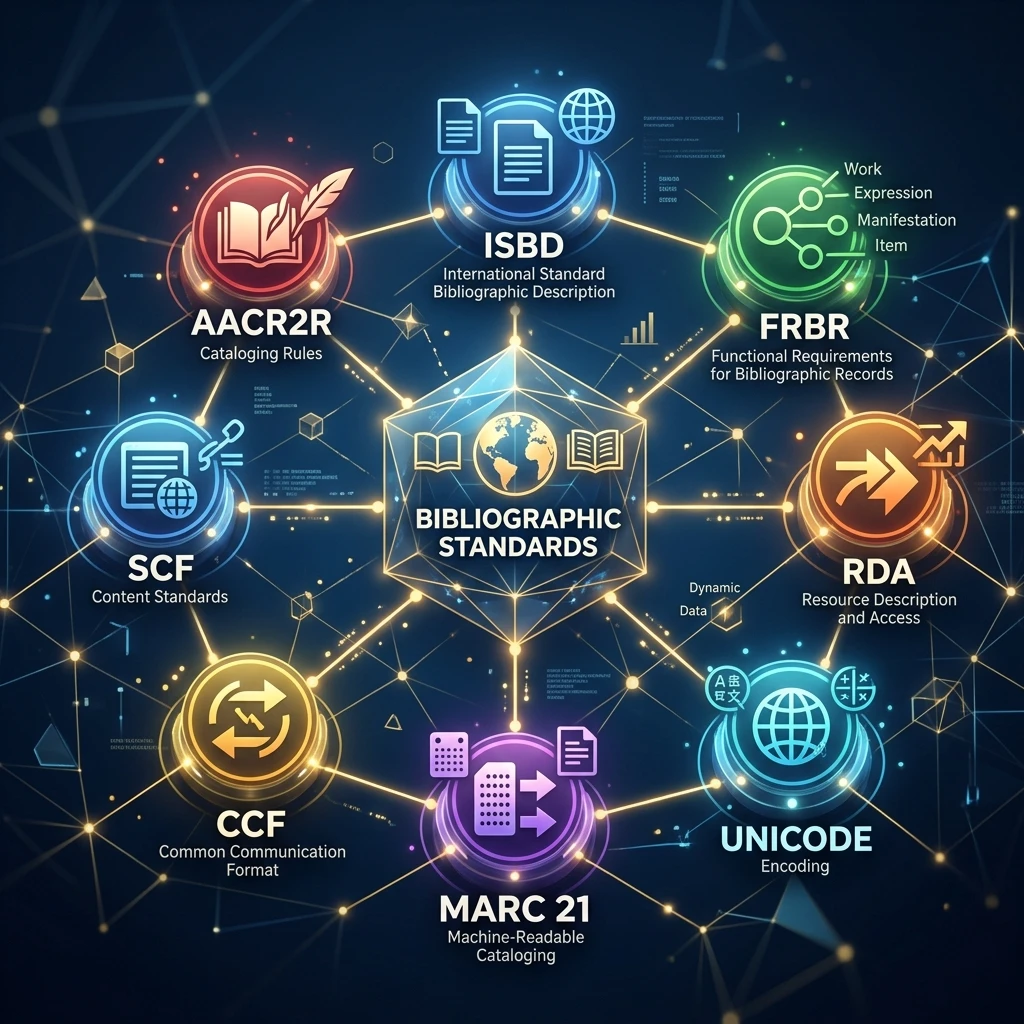
ISBD FRBR (WEMI) RDA CCF UNICODE
ISBD
International Standard Bibliographic Description — the 9 Areas, punctuation pattern, and how it standardises description across formats.
FRBR
Functional Requirements for Bibliographic Records — the WEMI model (Work, Expression, Manifestation, Item) and four user tasks: Find, Identify, Select, Obtain.
RDA
Resource Description & Access — successor to AACR2R. Core RDA elements mapped onto the entries and MARC 21 tags built earlier in the workshop.
CCF
Common Communication Format — structure, segments, and linking fields for information interchange between library systems.
UNICODE / ISCII
Character encoding essentials for bilingual and multi-script cataloguing — critical for Hindi + English MARC 21 records.
MARC 21 Structure
Leader, Directory, Control & Data Fields — how a completed catalogue entry translates into a full MARC 21 record for OPAC/ILS use.

✨ Workshop Key Features

🎥
Session Recordings
Recordings shared after every class — revise at your own pace anytime.
📄
Practice Sheets
Printable worked-example notes (Card + MARC 21) after each session.
💬
Live Interactive Sessions
Small-batch format for individual doubt resolution every session.
🌐
Bilingual Delivery
Hindi + English — accessible for learners from across India.
🎓
E-Certificate
Official Certificate of Participation issued on completion.
🏆
Grand Mock Test
Integrated mock on Day 10 covering all 20 case types + framework quiz.
Limited Seats — Reserve Your Spot

Ready to Master Library Cataloguing?

Join the 10-Day Master Workshop and build the practical cataloguing skills that set you apart — in exams, interviews, and everyday professional library practice.